
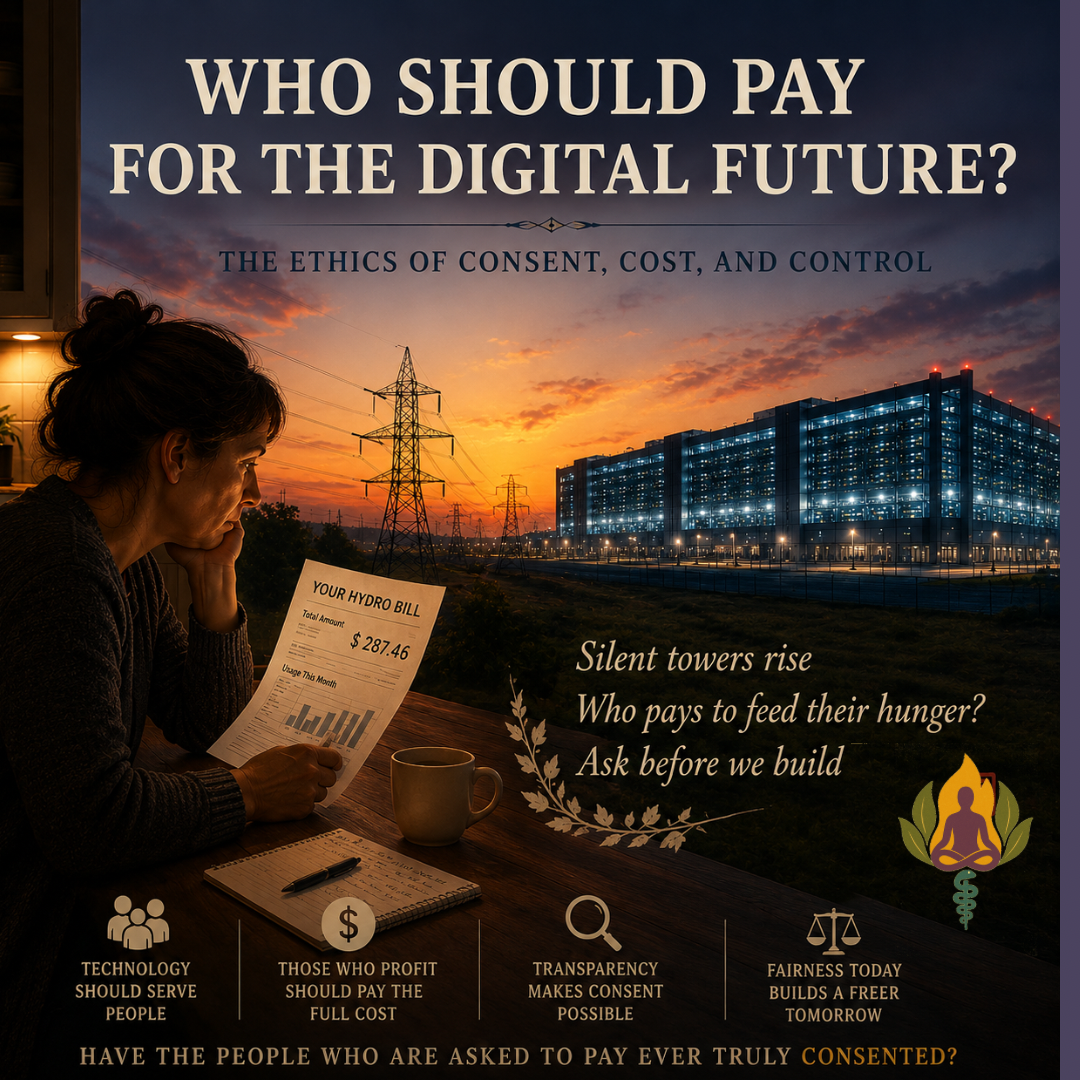
 Technology should amplify human wisdom, not replace human judgement.
It should serve people, not the other way around.
Ontario is racing to attract AI data centres. We are told they represent innovation, economic growth, and our digital future. At the same time, we’re being encouraged to conserve electricity, reduce our carbon footprint, and prepare for higher hydro bills because our electrical grid is under increasing strain.
The more I thought about it, the more I realized my concern about this wasn’t really about electricity. It was about hypocrisy, consent, and who pays for the future we’re building. The principles we ask citizens to live by should also apply to governments and corporations.
If our energy resources are becoming so precious that ordinary citizens are expected to use less, shouldn’t we be asking harder questions before welcoming some of the largest new industrial consumers of electricity?
More importantly, who should pay for the infrastructure they require?
Imagine your neighbour decides to build a factory beside your home.
He asks you to help pay for the new road.
He asks you to help pay for the upgraded electrical service.
He asks you to help pay for the water infrastructure.
He keeps the profits.
You get the bill.
Most of us would recognize immediately that something isn’t right.
So why is the conversation different when the project is measured in billions of dollars instead of one neighbourhood?
Let me be clear before anyone misunderstands my position.
I am not opposed to artificial intelligence.
In fact, I use AI almost every day. It has become the most valuable learning tool I’ve ever encountered. I use it to research ideas, challenge my assumptions, improve my writing, and deepen my understanding of the world.
I don’t use AI to avoid thinking.
I use AI to think more.
To me, that distinction matters.
AI can become a substitute for human thought, or it can become a catalyst for human wisdom. My hope is that we choose the second path.
The technology isn’t the problem.
The issue is the ethical framework surrounding its deployment.
Technology Should Serve People
Every significant technology changes society.
The question has never been whether technology is good or bad.
The question is: Who does it serve?
Does it increase human freedom?
Does it strengthen communities?
Does it help people become wiser, healthier, and more capable?
Or does it gradually encourage dependence, concentrate power, and reduce meaningful human choice?
For me, freedom has always been more important than convenience.
Convenience is a luxury. Freedom is a necessity.
Of course I want both. We all do.
But if I am forced to choose, I will choose freedom every time.
That principle shapes how I think about AI, digital infrastructure, and public policy.
It should serve people; not train people to serve it.
The Question That Isn’t Being Asked
Much of the public conversation focuses on whether AI will transform the economy.
I think that’s the wrong question.
The better question is this:
Who is paying for the transformation?
If a private company builds infrastructure primarily to advance its own commercial interests, should the public be expected to finance part of that infrastructure?
If a corporation profits from enormous computing capacity, should residential hydro customers bear any of the cost of expanding the electrical grid required to support it?
These aren’t anti-business questions.
They’re questions about fairness.
Those who create the demand for infrastructure should bear the full cost of that demand.
That principle applies whether we’re talking about factories, pipelines, shopping centres, or AI data centres.
To me, this isn’t a radical idea.
It’s simple responsibility.
Informed Consent or Backroom Deals?
We usually think of consent in terms of healthcare or personal relationships.
But consent is also a principle of good government.
Meaningful consent requires transparency.
People deserve to know what they’re paying for.
They deserve to understand who benefits.
They deserve an honest conversation before costs are shifted onto taxpayers or utility customers.
If governments believe expanding digital infrastructure is in the public interest, then they should explain why.
If taxpayers are expected to help finance that expansion, they should know exactly what they’re funding.
That’s what informed consent looks like in a democracy.
Without transparency, consent becomes little more than assumption.
The Hypocrisy of Hidden Subsidies
One of my concerns is not simply the existence of data centres.
It is the possibility that ordinary citizens could end up paying for infrastructure that primarily serves private commercial and government surveillance objectives.
If new transmission lines, substations, generating capacity, or other grid upgrades are required for large industrial projects, then the public deserves complete transparency.
Who pays?
Who benefits?
Who profits?
If governments believe public investment is justified, they should make that case openly.
If private companies expect extraordinary profits, then they should also accept extraordinary responsibility.
Profit and responsibility should travel together.
Not in opposite directions.
The Cost of Surveillance
My concern isn’t simply that data centres consume enormous amounts of electricity.
It is also worth asking what an increasing share of that computing power is actually being used for.
Some of it supports valuable work: scientific research, communications, education, healthcare, and the AI tools that many of us now use every day.
But another growing portion supports the collection, storage, analysis, and commercialization of human behaviour.
Some surveillance is conducted by governments. Much of it is conducted by private corporations whose business models depend on understanding, predicting, and influencing our choices.
I am uneasy about surveillance in all its forms, although I recognize that some uses are more concerning than others.
What I object to most is being asked to help finance the infrastructure that makes such surveillance possible.
If governments or corporations choose to build systems that collect, analyze, and profit from our data, then they, not the people being observed, should bear the full cost of the infrastructure required to support those systems.
Don’t send me the bill for my own surveillance.
The Long-Term Stakes
This conversation is not just about electricity bills or infrastructure costs.
It is about the kind of society we are building.
If we normalize a system where large-scale private ventures rely on public resources without clear accountability, we risk creating an imbalance that becomes harder to correct over time.
Economic growth matters.
Innovation matters.
But so does trust.
And trust is built when people feel that systems are fair, transparent, and grounded in shared responsibility.
If citizens begin to feel that they are consistently asked to carry costs without sharing in the benefits, that trust begins to erode.
Once lost, it is not easily restored.
A Better Way Forward
None of this means we should reject AI or digital infrastructure.
It means we should approach it with clarity and intention.
We can welcome innovation while still asking responsible questions.
We can support economic development while ensuring that costs are allocated fairly.
We can build the future without compromising the principles which make that future worth living in.
This requires leadership.
It requires honesty.
And it requires a willingness to have conversations that go beyond slogans and headlines.
Freedom is more important to me than convenience. That’s why consent matters. That’s why transparency matters. And that’s why I believe technology must always remain accountable to the people it is meant to serve.
The Questions We Should All Be Asking
At the end of the day, this is not a technical issue.
It is a moral one.
When we invest in the future, we are making choices about who carries the burden and who receives the benefit.
Those choices should never be made without our express knowledge and consent.
They should be discussed openly, debated honestly, and decided with the full awareness of the people they affect.
Because the digital future is not something that happens to us.
It is something we build together.
And if we are building it together, then we all deserve a voice in how it is shaped; and how it is paid for.
If surveillance is your business model, You finance it. Don’t ask me to pay for the infrastructure required to monitor, influence, and profit from me.
Three Questions to Sit With
- Who benefits?
- Who pays?
- Who consented?
The answers to those questions may determine not only how we build the digital future, but whether that future ultimately serves humanity; or asks humanity to serve it.