 “Technology should expand human agency, not reduce it.”
Every powerful technology asks something of us.
Some expand our capabilities. Others ask us to surrender a little of our independence in exchange for greater convenience.
The real question is not whether artificial intelligence, digital identity, automation, or predictive algorithms are good or bad.
The question is far more fundamental.
Do they expand our capacity to exercise judgement, discernment, and meaningful choice; or do they diminish it?
That question matters because I believe freedom is not simply the absence of rules.
Freedom is agency.
It is the ability to make meaningful choices and to live with the consequences of those choices.
Without that, we may become more efficient.
We may even become safer.
But we also become less human.
Freedom Is Agency
People often speak of freedom as though it were something governments either grant or deny.
I see it differently.
Freedom lives inside every meaningful decision we are allowed to make for ourselves.
It is present when we choose our own path, accept responsibility for the consequences, and adjust our behaviour as we learn.
That process is how judgement develops.
That process is how discernment develops.
That process is how wisdom develops.
Without meaningful choice, wisdom cannot grow.
That is why I believe the right to make mistakes is one of the most precious freedoms we possess.
Not because mistakes are desirable.
Because they are often our greatest teachers.
If my GPS recommends a different route, I want the freedom to ignore it.
Perhaps I’ll discover there was an accident ahead and the GPS was right.
The next time I may choose differently.
Or perhaps I’ll discover a beautiful road I had never travelled before.
Either way, I learn something.
The destination matters.
But so does becoming the kind of person who learns to navigate life with increasing wisdom.
Delegating Effort Is Not the Same as Delegating Judgement
Convenience has enormous value.
I use online banking.
I send electronic transfers.
I use artificial intelligence almost every day.
I am grateful for technologies that save time, reduce repetitive labour, and help me accomplish more than I could alone.
I am perfectly happy to delegate effort.
I never want to delegate my judgement.
To me, that is a line worth defending.
Technology should carry our bags.
It should not carry our conscience.
It should perform calculations.
It should not replace discernment.
It should help us think more clearly.
It should never relieve us of the responsibility of thinking.
That distinction may become one of the defining ethical questions of our time.
How Wisdom Is Earned
Human beings learn in a remarkably simple way.
We choose.
We act.
We make mistakes.
We reflect.
We adjust.
We become wiser.
No algorithm can live that process for us.
No machine can acquire wisdom on our behalf.
Wisdom is not information.
It is not intelligence.
It is not computational power.
It is the integration of experience, reflection, humility, and judgement.
That is why I become uneasy whenever technology begins replacing decisions rather than supporting them.
A calculator replaces arithmetic.
That doesn’t concern me.
A washing machine replaces labour.
Wonderful.
But when increasingly intelligent systems begin making decisions that shape our lives while our own capacity for discernment atrophies, something profoundly important is being lost.
Not efficiency.
Not productivity.
Human development.
We do not become wiser because someone, or something, always gives us the correct answer.
We become wiser by wrestling with reality ourselves.
The Shrinking Dance Floor
One of the images that keeps returning to me is that of a dance floor.
Imagine that every year it becomes just a little smaller.
At first you hardly notice.
There is still plenty of room to move.
Then another section disappears.
Another rule.
Another requirement.
Another digital dependency.
Another human interaction replaced by automation.
None of these changes seems particularly significant on its own.
Taken together, however, they gradually reduce the space within which we exercise genuine freedom.
I don’t object to self-checkout.
I object to self-checkout becoming my only option.
I don’t object to digital payments.
I object to losing the freedom to use cash.
I don’t object to artificial intelligence making recommendations.
I object to living in a world where its recommendations become expectations, and expectations become obligations.
The issue has never been convenience.
The issue is preserving our capacity to choose.
Technology should continually expand the dance floor of human possibility.
Not reduce it.
Prediction Is Not the Problem
I’ve spent much of my life fascinated by systems that help us understand human behaviour.
Psychology.
Personality typing.
Astrology.
Numerology.
Even artificial intelligence.
Understanding people is not the problem.
Prediction is not the problem.
Manipulation is.
There is a profound ethical difference between helping people understand themselves and using that understanding to influence, steer, or restrict their choices without their knowledge or meaningful consent.
Knowledge can expand freedom.
Manipulation diminishes it.
I want to understand people more deeply.
I do not want to become better at controlling them.
That distinction matters.
How Judgement Develops
This principle becomes obvious when we watch children grow.
Children don’t develop good judgement by having every decision made for them.
They develop it by making choices, experiencing consequences, reflecting on what happened, and trying again.
Of course, parents have a responsibility to protect children from serious harm.
But there is an important difference between protection and overprotection.
If we never allow children to fall, they never learn how to regain their balance.
If we solve every problem for them, they never develop confidence in their own discernment.
Eventually they stop trusting themselves.
The same principle applies throughout life.
Whether the decisions are made by overprotective parents, governments, corporations, or increasingly intelligent technologies, the result is remarkably similar.
When we outsource judgement, we gradually lose the opportunity to develop it.
That is a price I am unwilling to pay.
The Right to Be Wrong
Perhaps the greatest danger isn’t artificial intelligence.
It is the temptation to surrender our judgement in exchange for greater convenience.
Every generation inherits powerful new tools.
Our responsibility is to ensure that they strengthen our capacity to choose rather than replace it.
A world in which every decision is optimized for us may become safer, faster, and more efficient.
It also makes us less human.
The goal of technology should never be to make us unnecessary.
Its purpose should be to help us become wiser, more capable, and more fully human.
Judgement cannot simply be handed to another intelligence without changing something fundamental about who we become.
It is earned.
Choice by choice.
Experience by experience.
Reflection by reflection.
That is why I believe one of our most precious freedoms is the right to be wrong.
Not because being wrong is desirable.
But because without the freedom to be wrong, there can be no genuine freedom to choose.
Without the freedom to choose, there can be no responsibility.
Without responsibility, there can be no discernment.
And without discernment, wisdom cannot grow.
Every generation inherits extraordinary new tools.
The question is not whether we will use them.
The real question is this:
What must we never surrender?
For me, the answer is clear.
Our agency.
Our judgement.
Our discernment.
Our humanity.
⸻
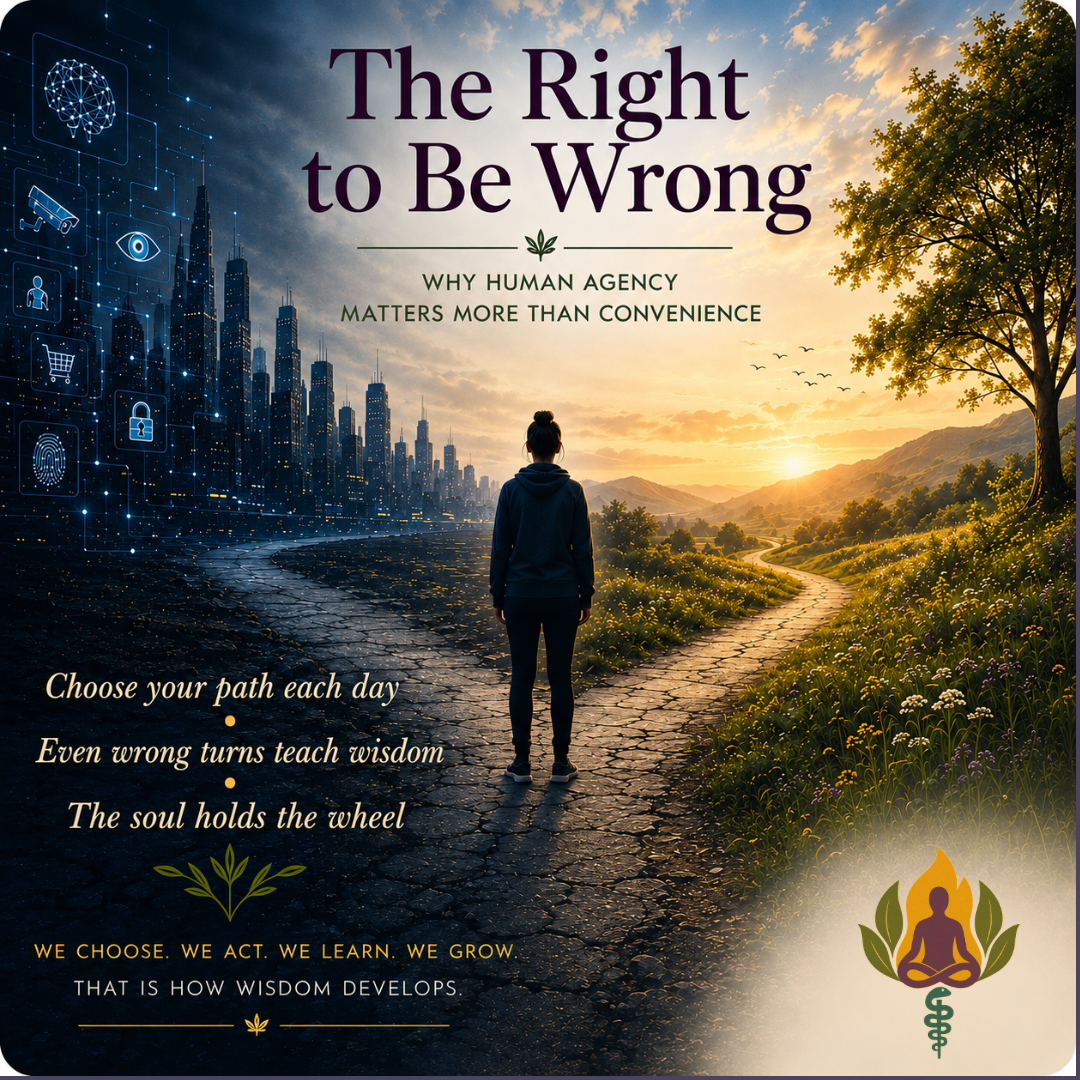
We don’t develop wisdom by being protected from every mistake. We develop it by making choices, living with the consequences, and refining our judgement.
⸻
Haiku
Choose your path each day
Even wrong turns teach wisdom
The soul holds the wheel
⸻