 A man sat across from me recently and shared something that stayed with me long after our conversation ended.
He is sixty-five years old.
He has been married twice.
He told me that he had never been in an intimate relationship.
Not because he did not want intimacy, but because somewhere in childhood he learned that opening his heart was not safe.
His story is particular.
The pattern is universal.
At some point in life, every one of us experiences pain. We are betrayed, rejected, humiliated, abandoned or frightened. Our nervous systems remember. We become strongly motivated to prevent the pain from happening again.
So we build walls.
Sometimes they are physical. More often they are emotional, intellectual, spiritual or relational.
The problem is not that we build them. Some walls are necessary. Healthy boundaries protect us from genuine danger. Closing the gate to someone who repeatedly violates our trust is not a failure of openness. It is wisdom.
The question is whether we still remember why the wall was built—and whether the danger it protected us from is still present.
Fear of further pain can become the architect of our lives. Its purpose is protection, but fear tends to generalize.
One person betrays us, and trusting anyone begins to feel dangerous.
One relationship wounds us, and intimacy itself becomes suspect.
One painful failure convinces us never to risk trying again.
Eventually, the walls keep out far more than pain.
They keep out love.
Friendship.
Creativity.
Wonder.
Adventure.
New ideas.
The possibility of being surprised by life.
For years, I would have said that the opposite of fear is love. I still believe love can take us beyond fear, but love may not be the first step.
The bridge is curiosity.
Fear asks:
How do I make sure this never hurts me again?
Curiosity asks:
What am I not seeing because I’m afraid?
Fear reacts.
Curiosity pauses.
Fear narrows our capacity for discernment.
Curiosity begins to restore it.
When we become curious instead of reacting unconsciously, our capacity to be present is greatly enhanced. We become more available to our own experience and to the experience of the person in front of us.
We can notice the sensations in our bodies, the stories forming in our minds and the assumptions we are making before those assumptions harden into conclusions.
Curiosity does not require us to dismiss fear. It allows us to listen to fear without automatically obeying it.
What is this fear trying to protect?
Is the danger here now, or is my body remembering something from the past?
What assumptions am I making?
What else might be true?
Better questions do more than create interesting conversations.
They help us live wiser lives.
Curiosity creates the pause in which discernment becomes possible. Discernment then helps us distinguish between the fear that keeps us safe and the fear that keeps us stuck.
Sometimes wisdom closes the gate.
Sometimes wisdom opens it.
The same dynamic that shapes an individual life also operates within families, organizations, communities and entire societies.
Collective pain creates collective fear. A community that has experienced violence may become suspicious of outsiders. A country that has been attacked may accept restrictions it would previously have rejected. A population repeatedly warned of catastrophe may become more willing to surrender judgment, agency and freedom to those promising protection.
Some dangers are real.
Some warnings are necessary.
Fear itself is not proof of manipulation.
But because fear narrows our capacity for discernment, anyone who amplifies it acquires influence over us.
That makes curiosity especially important when the message comes from people or institutions with power.
Human behaviour is rarely without motivation. Sometimes our motivations are deliberate and apparent. Often they are mixed, hidden even from ourselves or shaped by incentives we barely notice.
We avoid pain.
We seek belonging.
We want security, recognition, money, influence, status or control.
Institutions are made of people and shaped by incentives of their own. Governments seek authority and continuity. Businesses seek revenue. Media organizations compete for attention. Political movements seek votes and allegiance. Advocacy organizations seek support for their causes.
Even institutions founded with honourable intentions can become invested in preserving their relevance, increasing their reach or defending their previous decisions.
Recognizing this is not cynicism.
It is discernment.
“Follow the money” is shorthand for a much broader inquiry:
What forces are at work here?
What incentives might be shaping this message?
Who gains money, power, attention, status or control if my fear increases?
Who bears the cost of the proposed solution?
Is the danger being described in proportion to the evidence?
What information or perspectives have been omitted?
Does this person want me to understand—or merely to comply?
None of these questions proves manipulation. They help us become less vulnerable to it.
The point is not to trust no one. Universal distrust is another wall, and it can imprison us as effectively as unquestioning faith.
Nor is the answer to locate a leader, expert or institution to whom we can permanently surrender our judgment.
People may earn our confidence through honesty, competence, humility and a demonstrated willingness to limit or relinquish power. But healthy trust remains provisional. It leaves the gate capable of opening and closing as new evidence emerges.
A healthy society should not merely protect people from every possible discomfort or danger. It should cultivate people capable of meeting uncertainty with curiosity, evaluating evidence, recognizing incentives and making increasingly wise choices for themselves.
Good parenting moves in that direction. The purpose is not lifelong control but the gradual development of judgment. Rules may protect a child while discernment is still developing, but the goal is an adult capable of choosing wisely without constant supervision.
Should civilization aspire to anything less?
Perhaps becoming fully alive does not require tearing down every wall.
Perhaps it requires learning which gates to open.
Life has always been untamed.
Love is untamed.
Intimacy is untamed.
Nature is untamed.
Creativity is untamed.
Freedom is untamed.
None can be reduced to perfect safety without losing something essential.
The next time you notice yourself becoming anxious, reactive or afraid, pause before deciding what the feeling means or what you must do about it.
Become curious.
What is my fear trying to protect?
Is this fear keeping me safe—or keeping me stuck?
What am I not seeing because I’m afraid?
What becomes possible when I remain curious just a little longer?
Perhaps wisdom is not having fewer fears.
Perhaps it is learning to meet fear with enough curiosity that it no longer gets the final vote.
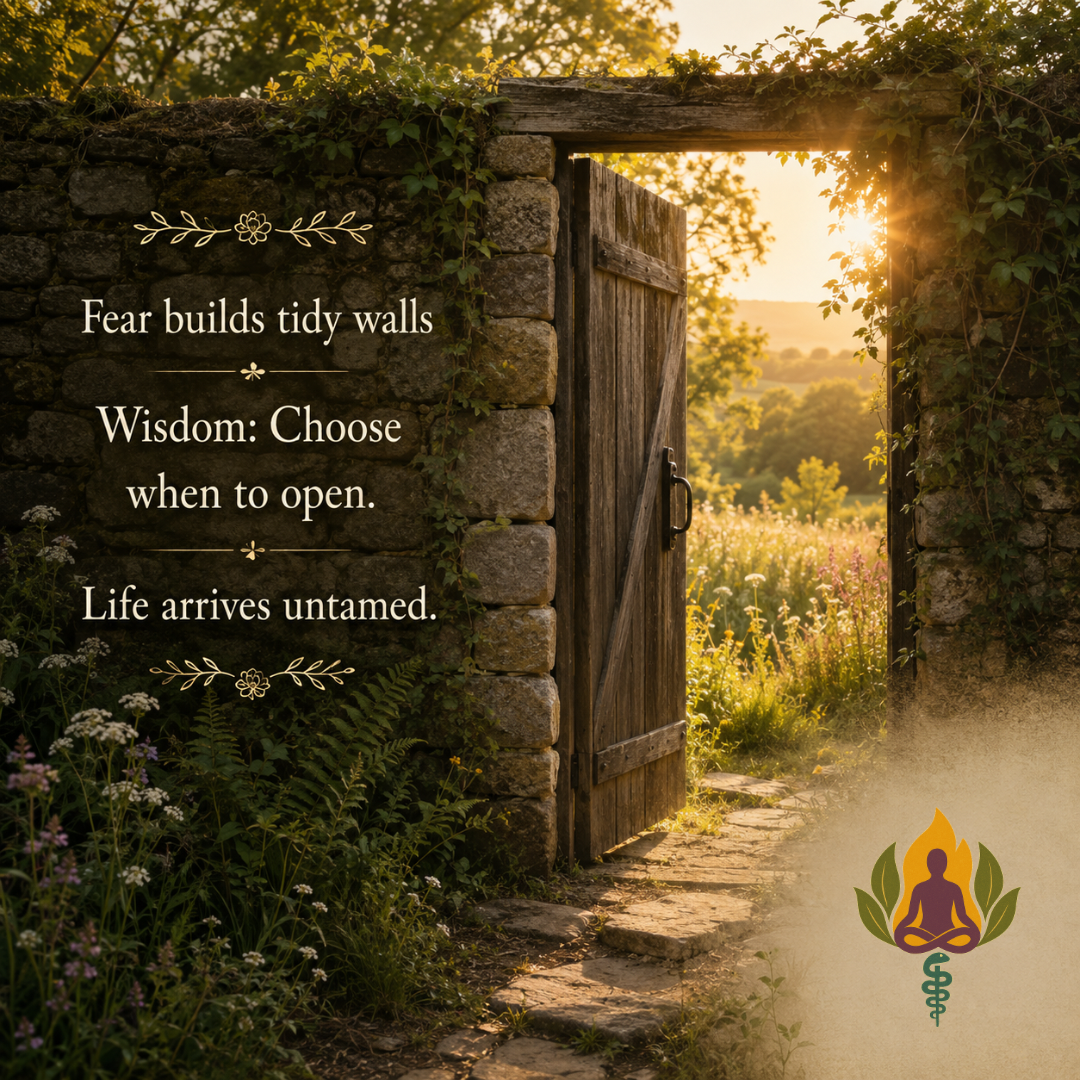
Fear builds tidy walls
Wisdom: Choose when to open.
Life arrives untamed.